


Last updated 7 months ago.
Lexicon of Crisis: US Tariffs and Tunisia’s Institutional Atrophy | Media Arabic Booster 02/26
How does the Egyptian press frame the economic fallout of new US tariffs? Why are commentators lamenting Tunisia’s systemic collapse? This Media Arabic Booster analyzes Al-Masry Al-Youm’s messaging on global trade coercion and decodes the vocabulary of institutional atrophy playing out in Al-Quds Al-Arabi.

How does the Arab press articulate the looming specter of a global trade war? And what terminology captures the gradual erosion of a nation’s civic infrastructure?
This Media Arabic Booster scrutinizes the lexicon of economic anxiety and systemic collapse, deconstructing a prominent Egyptian front page detailing the ramifications of US tariffs and dissecting a poignant Tunisian editorial on institutional entropy.
First, we examine a front page of Al-Masry Al-Youm (المصري اليوم). We analyze how the newspaper utilizes specific vocabulary – focusing on “uncertainty”, “competitiveness”, and “tariffs” – to frame the global and domestic economic fallout sparked by Donald Trump’s newly enacted trade policies.
Then, we pivot to North Africa. By parsing an opinion piece from the London-based daily Al-Quds Al-Arabi (القدس العربي), we observe how Tunisia’s profound institutional atrophy is chronicled in print. We explore the vocabulary of public neglect, escalating crime, and political stagnation.
Meticulously dissecting these texts reveals how contemporary social crises are debated within Arabic journalistic discourse.
A close look at a headline
Let’s start with the analysis of a headline.
al-Masry al-Youm: The Fallout of Global Tariffs
On Sunday, February 22, 2026, the Egyptian daily newspaper Al-Masry Al-Youm (االمصري اليوم) featured an analysis of the global and local economic fallout sparked by Donald Trump’s newly announced 10% global tariffs.
The report covers his controversial use of a 1974 trade law provision to bypass the Supreme Court, and examines how these shifting global supply chains are expected to create mixed results for Egypt’s export sectors.

Remark: If you want to read the full article, try this link (or: archive.org)
Let’s focus on the entire front page.
«عدم اليقين» يسيطر على العالم بسبب «رسوم ترامب» الجديدة
“Uncertainty” grips the world because of “Trump’s new tariffs”
«نيويورك تايمز»: ستبقى طالما ظلّ الرئيس الأمريكى فى منصبه.
The New York Times: They will remain in place as long as the U.S. president stays in office.
اقتصاديون: «الرسوم» تهدد تنافسية صادرات مصر الهندسية
Economists: The “tariffs” threaten the competitiveness of Egypt’s engineering exports.
Translation of an article
Let’s look at parts of a longer newspaper article in Arabic. We will translate each sentence carefully. The highlighted words are in the vocabulary list below.
Al-Quds Al-Arabi: Tunisia’s Institutional Atrophy
Published on February 17, 2026, this opinion piece in Al-Quds Al-Arabi (القدس العربي) uses a recent kindergarten scandal in Tunis as a starting point to critique Tunisia’s profound societal and institutional decay.
The author details a widespread breakdown in basic services – from schools and hospitals to public administration and street safety – arguing that this everyday chaos reflects a much deeper political crisis. Ultimately, the piece holds Tunisia’s current leadership responsible, accusing them of prioritizing political suppression over the rule of law and societal welfare.
The article was written by Mohamed Krishan (محمد كريشان), a Tunisian journalist and long-time senior presenter and political analyst at Al Jazeera. His writing frequently covers complex political and social developments in the Arab world, often highlighting internal challenges within Tunisia and adopting a critical tone toward political stagnation.
Al-Quds Al-Arabi (القدس العربي) is an independent pan-Arab daily newspaper based in London, founded in 1989. It is widely known for its editorial stance critical of various authoritarian Arab regimes, its extensive coverage of the Palestinian cause, and its role as a prominent platform for Arab intellectuals and journalists offering perspectives outside of state-controlled media.
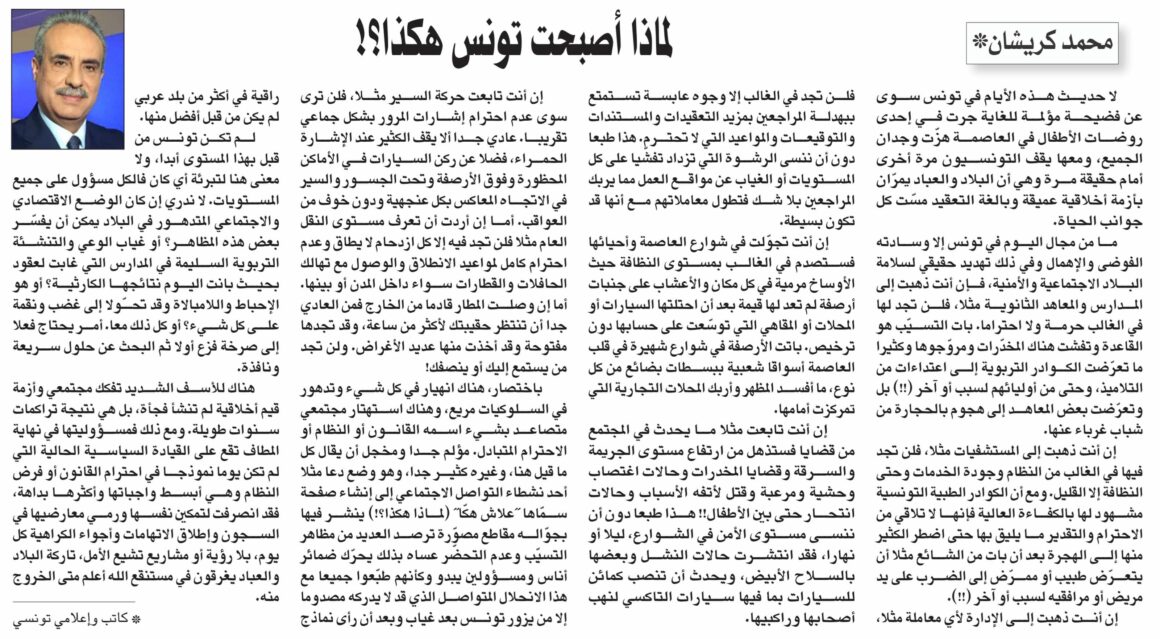
Remark: If you cannot access the article, try the pdf version.
لماذا أصبحت تونس هكذا؟!
Why has Tunisia become like this?!
Let’s now take a closer look at the entire article.
Section 1
لا حديث هذه الأيام في تونس سوى عن فضيحة مؤلمة للغاية جرت في إحدى روضات الأطفال في العاصمة هزّت وجدان الجميع، ومعها يقف التونسيون مرة أخرى أمام حقيقة مرة وهي أن البلاد والعباد يمرّان بأزمة أخلاقية عميقة وبالغة التعقيد مسّت كل جوانب الحياة.
These days in Tunisia, the only topic of conversation (literal: there is no talk these days in Tunisia except about) is a deeply painful scandal that occurred in a kindergarten in the capital [➤ see info box below], shaking the conscience of the entire nation (literal: shaking the conscience of everyone). This incident has once again confronted Tunisians with the bitter reality that the country and its people (literal idiom: the country and the servants/worshippers of God) are experiencing a profound and complex moral crisis affecting every aspect of life.
ما من مجال اليوم في تونس إلا وسادته الفوضى والإهمال وفي ذلك تهديد حقيقي لسلامة البلاد الاجتماعية والأمنية، فإن أنت ذهبت إلى المدارس والمعاهد الثانوية مثلا، فلن تجد لها في الغالب حرمة ولا احتراما.
There is hardly any area (literal: there is no field) in Tunisia today that is not plagued by (literal: except that it is prevailed over/mastered by) chaos and neglect, posing a real threat to the country’s social and security well-being. If you visit schools and secondary institutes, for example, you will often find neither sanctity nor respect for them.
بات التسيّب هو القاعدة وتفشت هناك المخدّرات ومروّجوها وكثيرا ما تعرّضت الكوادر التربوية إلى اعتداءات من التلاميذ، وحتى من أوليائهم لسبب أو آخر (!!) بل وتعرّضت بعض المعاهد إلى هجوم بالحجارة من شباب غرباء عنها.
Laxity/Indiscipline (literal: looseness/neglect) has become the norm, drugs and their dealers are rampant, and educational staff are frequently subjected to attacks by students, and even their parents, for one reason or another. Some institutes have even been attacked with stones by young people who have no connection to them (literal: youth strangers to them).
إن أنت ذهبت إلى المستشفيات مثلا، فلن تجد فيها في الغالب من النظام وجودة الخدمات وحتى النظافة إلا القليل. ومع أن الكوادر الطبية التونسية مشهود لها بالكفاءة العالية فإنها لا تلاقي من الاحترام والتقدير ما يليق بها حتى اضطر الكثير منها إلى الهجرة بعد أن بات من الشائع مثلا أن يتعرّض طبيب أو ممرّض إلى الضرب على يد مريض أو مرافقيه لسبب أو آخر (!!).
If you visit hospitals, for instance, you will often find little to no (literal: you will not find in them… except a little of) order, quality of service, or even cleanliness. Although Tunisian medical professionals are renowned for their high competence (literal: attested to for their high competence), they do not receive the respect and appreciation they deserve (literal: that befits them). This has forced many of them to emigrate, as it has become commonplace, for example, for a doctor or nurse to be assaulted (literal: subjected to beating) by a patient or their companions for one reason or another.
Backstory: The Kindergarten Assault in Tunis
A shocking case of alleged child abuse at a local nursery in early 2026 ignited fierce protests and a high-profile criminal investigation in the Greater Tunis area.
- When: The incident occurred in late January 2026. The mother filed an initial complaint that was reportedly not treated with urgency, prompting her to share her testimony on social media in mid-February 2026, which triggered the massive public response.
- Where: The incident took place at a private kindergarten in Ennasr 2 (النصر 2), an affluent neighborhood in Ariana (مدينة أريانة). Ariana is a major city and governorate that forms part of the Greater Tunis metropolitan area, located just north of the capital city of Tunis.
- The Victim: A three-year-old boy enrolled at the facility. According to his mother’s testimony, the child also indicated that other children may have been subjected to similar abuse.
- The Perpetrators: While authorities have strictly guarded their identities to protect the integrity of the investigation, the Public Prosecutor’s office ordered the arrest and detention of four individuals. This includes the primary suspect accused of the direct assault, as well as three others connected to the kindergarten (likely staff or management) accused of negligence, facilitation, or failing to protect the children.
What Happened Later
- Facility Closed: The Ministry of Family swiftly ordered the immediate closure of the kindergarten.
- Criminal Investigation: The Public Prosecutor launched a formal probe, ordering forensic and psychological exams for the child, DNA testing, and the seizure of the facility’s surveillance footage.
- Protests & Demands: Outrage over initial delays in the case led to major protests outside the Ariana courthouse on February 16, 2026. Civil society groups demanded maximum judicial penalties for the perpetrators, accountability for the facility’s management, and a strict overhaul of national child protection laws.
Section 2
إن أنت ذهبت إلى الإدارة لأي معاملة مثلا، فلن تجد في الغالب إلا وجوه عابسة تستمتع ببهدلة المراجعين بمزيد التعقيدات والمستندات والتوقيعات والمواعيد التي لا تحترم. هذا طبعا دون أن ننسى الرشوة التي تزداد تفشّيا على كل المستويات أو الغياب عن مواقع العمل مما يربك المراجعين بلا شك فتطول معاملاتهم مع أنها قد تكون بسيطة.
If you go to a government office (literal: the administration) for any transaction, you will most likely find only frowning faces that seem to enjoy humiliating (literal: making a mess of / degrading) those seeking services (literal: the reviewers / applicants) with excessive complications, paperwork, signatures, and appointments that are never respected. This is, of course, without forgetting the rampant bribery at all levels, or the absenteeism from work, which undoubtedly confuses those seeking services and prolongs their transactions (literal: so their transactions lengthen), even though they might be simple.
إن أنت تجوّلت في شوارع العاصمة وأحيائها فستصدم في الغالب بمستوى النظافة حيث الأوساخ مرمية في كل مكان والأعشاب على جنبات أرصفة لم تعد لها قيمة بعد أن احتلتها السيارات أو المحلات أو المقاهي التي توسّعت على حسابها دون ترخيص.
If you walk through the streets and neighborhoods of the capital, you will likely be shocked by the level of cleanliness. Garbage is strewn everywhere, and weeds line the sides of sidewalks that have become worthless after being taken over by cars, shops, or cafes that have expanded at their expense (literal translation added) without permits.
باتت الأرصفة في شوارع شهيرة في قلب العاصمة أسواقا شعبية ببسطات بضائع من كل نوع، ما أفسد المظهر وأربك المحلات التجارية التي تمركزت أمامها.
Sidewalks in famous streets in the heart of the capital have become makeshift popular markets with stalls of goods (literal translation added) of all kinds, spoiling the appearance and disrupting (literal: confusing) the businesses that have set up shop in front of them.
إن أنت تابعت مثلا ما يحدث في المجتمع من قضايا فستذهل من ارتفاع مستوى الجريمة والسرقة وقضايا المخدرات وحالات اغتصاب وحشية ومرعبة وقتل لأتفه الأسباب وحالات انتحار حتى بين الأطفال!!
If you were to follow the issues plaguing our society (literal: what happens in society of issues), you would be astonished by the soaring crime rates: theft, drug offenses, brutal and horrific rapes, murders for the most trivial reasons, and even suicides among children!
هذا طبعا دون أن ننسى مستوى الأمن في الشوارع، ليلا أو نهارا، فقد انتشرت حالات النشل وبعضها بالسلاح الأبيض، ويحدث أن تنصب كمائن للسيارات بما فيها سيارات التاكسي لنهب أصحابها وراكبيها.
This is all without even mentioning the state of security on the streets, day and night. Pickpocketing has become rampant, some involving knives (literal idiom: white weapons), and ambushes are being set up for cars, including taxis, to rob (literal: to loot/plunder) their owners and passengers.
Section 3
إن أنت تابعت حركة السير مثلا، فلن ترى سوى عدم احترام إشارات المرور بشكل جماعي تقريبا. عادي جدا ألا يقف الكثير عند الإشارة الحمراء، فضلا عن ركن السيارات في الأماكن المحظورة وفوق الأرصفة وتحت الجسور والسير في الاتجاه المعاكس بكل عنجهية ودون خوف من العواقب.
If you were to observe traffic, for example, you would see almost universal disregard for traffic signals. It’s quite common for many to fail to stop at red lights, let alone park (literal: not to mention parking) cars in prohibited areas, on sidewalks, under bridges, and driving the wrong way with utter arrogance (literal: haughtiness) and without any fear of consequences.
أما إن أردت أن تعرف مستوى النقل العام مثلا فلن تجد فيه إلا كل ازدحام لا يطاق وعدم احترام كامل لمواعيد الانطلاق والوصول مع تهالك الحافلات والقطارات سواء داخل المدن أو بينها.
And if you were to examine the state of public transportation, for example, you would find nothing but unbearable overcrowding, a complete disregard for departure and arrival times, and dilapidated buses and trains, both within and between cities.
أما إن وصلت المطار قادما من الخارج فمن العادي جدا أن تنتظر حقيبتك لأكثر من ساعة، وقد تجدها مفتوحة وقد أخذت منها عديد الأغراض. ولن تجد من يستمع إليك أو ينصفك!
If you arrive at the airport from abroad, it’s quite common to wait for your luggage for over an hour, and you might find it open with many of your belongings removed. And you won’t find anyone to listen to you or give you justice (literal: or act fairly towards you)!
باختصار، هناك انهيار في كل شيء وتدهور في السلوكيات مريع، وهناك استهتار مجتمعي متصاعد بشيء اسمه القانون أو النظام أو الاحترام المتبادل.
In short, there’s a collapse in everything and a horrific decline in behavior (literal: a terrifying deterioration in behaviors). There’s a rising societal disregard (literal: recklessness) for anything resembling law, order, or mutual respect.
مؤلم جدا ومخجل أن يقال كل ما قيل هنا، وغيره كثير جدا، وهو وضع دعا مثلا أحد نشطاء التواصل الاجتماعي إلى إنشاء صفحة سمّاها “علاش هكّا” (لماذا هكذا؟!) ينشر فيها بجوّاله مقاطع مصوّرة ترصد العديد من مظاهر التسيّب وعدم التحضّر عساه بذلك يحرّك ضمائر أناس ومسؤولين يبدو وكأنهم طبّعوا جميعا مع هذا الانحلال المتواصل الذي قد لا يدركه مصدوما إلا من يزور تونس بعد غياب وبعد أن رأى نماذج راقية في أكثر من بلد عربي لم يكن من قبل أفضل منها.
It’s incredibly painful and shameful to have to say all of this, and much more besides. This situation prompted, for example, a social media activist to create a page called “Why is it like this?!” (Tunisian dialect: علاش هكّا) where he posts videos on his phone documenting numerous instances of laxity and lack of civility, hoping to (literal: perhaps he by that) stir the consciences of people and officials who seem to have become accustomed to (literal: normalized]) this ongoing decay.
This decay might only be truly shocking to those who visit Tunisia after a long absence and have witnessed more refined examples in other Arab countries that were not previously superior to it.
Tunisia: A Century of Autocracy, Uprising, and Backsliding
Tunisia’s history is defined by dramatic shifts. This timeline traces the nation’s turbulent path from early independence and the 2011 Arab Spring to its fragile democratic transition and recent democratic backsliding.
Pre-2010: Independence & Autocracy
- 1881–1956 (French Protectorate): Tunisia spends the first half of the 20th century under French colonial rule. Nationalist mobilization intensifies, especially under the Neo Destour Party (الحزب الحر الدستوري الجديد), founded in 1934.
- 1956: Tunisia gains independence from France on March 20.
- 1957: The Republic is declared. Habib Bourguiba (حبيب بورقيبة) becomes president. He acts as an authoritarian modernizer, introducing major reforms (like advancing women’s rights and expanding education) while establishing a de facto one-party state under the Socialist Destourian Party (الحزب الاشتراكي الدستوري).
- 1987: Prime Minister Zine El Abidine Ben Ali (زين العابدين بن علي) removes Bourguiba in a “medical coup.” Ben Ali establishes a deeply authoritarian regime characterized by an extensive security apparatus, media censorship, and political repression that lasts for 23 years.
2010–2014: The Revolution & Democratic Transition
- December 17, 2010: A young street vendor, Mohamed Bouazizi (محمد البوعزيزي), self-immolates in Sidi Bouzid (سيدي بوزيد). While his act is the symbolic catalyst, the ensuing protests are heavily fueled by long-standing unemployment, corruption, and regional inequality, igniting the Revolution (الثورة) and the wider “Arab Spring” as the revolution is called in the West.
- January 14, 2011: After massive nationwide protests, President Ben Ali flees to Saudi Arabia. The regime collapses.
- October 2011: Tunisians vote in free elections to form a Constituent Assembly. The moderate Islamist Ennahda Movement (النهضة) wins a plurality of the vote (approx. 37%).
- 2013: The country faces a severe crisis following the assassinations of two prominent left-wing politicians: Chokri Belaid (شكري بلعيد) and Mohamed Brahmi (محمد البراهمي).
- 2014: The Tunisian National Dialogue Quartet (الرباعي الراعي للحوار الوطني) successfully mediates the crisis (later winning the 2015 Nobel Peace Prize). A progressive, democratic constitution is adopted, and Beji Caid Essebsi (الباجي قائد السبسي) is elected president.
2019–2026: Democratic Backsliding & Return to Autocracy
- October 2019: Kais Saied (قيس سعيد), an independent constitutional law professor, is elected president in a landslide runoff.
- July 25, 2021: Citing political gridlock, President Saied suspends parliament, dismisses the prime minister, and assumes broad emergency powers. Opponents label the move a coup, marking the turning point toward democratic breakdown.
- July 2022: Saied pushes through a new constitution via a referendum with very low turnout (~30%). It vastly expands presidential authority and weakens the parliament and judiciary.
- 2023–2024: The government launches a severe crackdown on dissent. Opposition politicians, judges, journalists, and civil society activists are widely documented by human rights groups as being systematically arrested.
- October 2024: President Saied is re-elected with an official 90.7% of the vote. The election is characterized by a dismal turnout (~28.8%) and the arbitrary exclusion or imprisonment of major opposition candidates.
- 2025–2026: 15 years after the Revolution, Tunisia’s democratic institutions are significantly weakened. Economic crises persist (high inflation, unemployment), and localized civil unrest continues, such as major environmental protests over phosphate industry pollution in Gabes (قابس).
Section 4
لم تكن تونس من قبل بهذا المستوى أبدا، ولا معنى هنا لتبرئة أي كان فالكل مسؤول على جميع المستويات. لا ندري إن كان الوضع الاقتصادي والاجتماعي المتدهور فservants/worshippersي البلاد يمكن أن يفسّر بعض هذه المظاهر؟ أو غياب الوعي والتنشئة التربوية السليمة في المدارس التي غابت لعقود بحيث بانت اليوم نتائجها الكارثية؟
Tunisia has never been this bad before, and there’s no point in absolving anyone (literal: there is no meaning here to acquit anyone); everyone is responsible at every level. We don’t know if the deteriorating economic and social situation in the country can explain some of these manifestations?
أو هو الإحباط واللامبالاة وقد تحوّلا إلى غضب ونقمة على كل شيء؟ أو كل ذلك معا. أمر يحتاج فعلا إلى صرخة فزع أولا ثم البحث عن حلول سريعة ونافذة.
Or is it the absence of awareness and proper upbringing in schools, which has been lacking for decades, the disastrous results of which are now evident? Or is it frustration and apathy that have transformed into anger and resentment towards everything? Or perhaps all of these factors coservants/worshippersmbined? This situation truly requires, first and foremost, a cry of alarm (literal: cry of panic), followed by a search for swift and effective (literal: penetrating) solutions.
هناك للأسف الشديد تفكك مجتمعي وأزمة قيم أخلاقية لم تنشأ فجأة، بل هي نتيجة تراكمات سنوات طويلة. ومع ذلك فمسؤوليتها في نهاية المطاف تقع على القيادة السياسية الحالية التي لم تكن يوما نموذجا في احترام القانون أو فرض النظام وهي أبسط واجباتها وأكثرها بداهة، فقد انصرفت لتمكين نفسها ورمي معارضيها في السجون وإطلاق الاتهامات وأجواء الكراهية كل يوم، بلا رؤية أو مشاريع تشيع الأمل، تاركة البلاد والعباد يغرقون في مستنقع الله أعلم متى الخروج منه.
Unfortunately, there is a societal disintegration and a crisis of moral values that did not arise suddenly, but rather is the result of years of accumulated problems (literal: accumulations). Ultimately, however, the responsibility lies with the current political leadership, which has never been a model of respect for the law or the enforcement of order, which is its most basic and obvious (literal: intuitive) duty.
Instead, it has focused on consolidating its power (literal: empowering itself), throwing its opponents in prison, and launching accusations and an atmosphere of hatred every day, without any vision or projects that inspire hope, leaving the country and its people (literal idiom: the country and the worshippers) to sink into a quagmire (literal: swamp) from which only God knows when they will emerge.
Vocabulary list
All the words in the above article marked in color can be found in this table with explanations.
If you are unfamiliar with the verb system used in the Hans Wehr dictionary (Roman numerals, I-X), click here for a short and simplified overview. To avoid confusion, we generally ignore auxiliary vowels that are necessary for pronunciation to avoid consonant clusters.
Part 1: Analysis of a headline
The following vocabulary list covers the yellow-marked words we saw in the headlines.
| English | Arabic |
| عَدَمٌ | lack; non-existence; absence. Verbal noun (مَصْدَر) of the sound (صَحِيح سَالِم) form I verb عَدِمَ – يَعْدَمُ (to lack/not have). Examples: lack of focus (عَدَمُ التَّرْكِيزِ); failure to respond (عَدَمُ الِاسْتِجَابَةِ). |
| يَقِينٌ | certainty; conviction. Verbal noun (مَصْدَرٌ) on the pattern فَعِيلٌ from the Form I verb يَقِنَ – يَيْقَنُ. Root: ي-ق-ن. Examples: I know for certain/I am confident that (أَنَا عَلَى يَقِينٍ بِأَنَّ); the truth of certainty (حَقُّ اليَقِينِ); uncertainty (عَدَمُ اليَقِينِ). Morphology Note: While this is the form I verbal noun, Arabic speakers rely heavily on it as the standard noun for the much more commonly used form IV verb أَيْقَنَ – يُوقِنُ (to be certain/to ascertain). The strict grammatical مَصْدَرٌ for that form IV verb is actually إِيقَان, but يَقِينٌ remains the universally preferred nounservants/worshippers in both classical and modern Arabic to express the core concept of “certainty”. |
| رَسْمٌ pl: رُسُومٌ | fee; tariff; duty. In economic and media contexts, it refers specifically to government-imposed charges or taxes. Examples: customs duties (رُسُومٌ جُمْرُكِيَّةٌ); registration fees (رُسُومُ التَّسْجِيلِ). |
| طَالَمَا | as long as; so long as; somtimes also: how often. This is a compound particle (حَرْف مُرَكَّب) consisting of the verb طَالَ (to be long) and the preventive ma (مَا الكَافَّة). In standard Arabic, every single verb strictly requires a subject (a doer). However, the مَا here acts as a shield or a blocker. It attaches to the verb and permanently “prevents” it from taking a subject. The result: Because the verb is neutralized and blocked from doing its normal job, the entire chunk (طَالَمَا) transforms into an adverbial conjunction. Watch out: Since it now functions as a linking word rather than an action, طَالَمَا cannot just be followed by a single noun. It must be followed by an entire, complete sentence (either a verbal or a nominal sentence). Examples: as long as you are with me (طَالَمَا أَنْتَ مَعِي); as long as the possibility exists (طَالَمَا كَانَ الِاحْتِمالُ قَائِمًا). |
| ظَلَّ – يَظَلُّ | to remain; to stay; to continue to be. Form I verb; doubled (مُضَعَّف) type. It is one of the Sisters of Kana (أَخَوَات كَانَ), functioning as an incomplete verb (فِعْل نَاقِص). Examples: The situation remained stable (ظَلَّ الوَضْعُ مُسْتَقِرًّا). Watch out: The “subject” (اِسْم ظَلَّ) is nominative (مَرْفُوع) and its “predicate” (خَبَر ظَلَّ) is accusative (مَنْصُوب). |
| مَنْصِبٌ pl: مَنَاصِبُ | office; position. In the context of the article, it is a deverbal noun denoting a professional post or rank, derived from the Form I verb نَصَبَ – يَنْصِبُ (to set up). Examples: a high-level position (مَنْصِبٌ رَفِيعٌ). He left office (تَرَكَ المَنْصِبَ). |
| اقْتِصَادِيٌّ pl: اقْتِصَادِيُّونَ | economist. Nisba adjective (نِسْبَة) derived from اقْتِصَادٌ (economy), the Masdar of the Form VIII verb اقْتَصَدَ. Example: economic growth (نُمُوٌّ اقْتِصَادِيٌّ). Watch out: In the nominative case (حَالَة الرَّفْع), it ends in ـُون, but in the accusative/genitive, it changes to ـِين. |
| تَنَافُسِيَّةٌ | competitiveness. This is an artificial verbal noun (مَصْدَر صِنَاعِيّ), formed by adding ـِيَّة to the adjective تَنَافُسِيّ. It relates to the Form VI verb تَنَافَسَ – يَتَنَافَسُ (to compete). Example: the competitiveness of the sector (تَنَافُسِيَّةُ القِطَاعِ). Remark: Form VI verbs generally denote reciprocity (مُشَارَكَة) between two or more parties. |
| صادِرٌ pl: صَادِرَاتٌ | export. Mainly used in the plural (جَمْع مُؤَنَّث سَالِم). It is the active oarticiple (اِسْم فَاعِل) of the Form I verb صَدَرَ – يَصْدُرُ (to go out/issue). Examples: total exports (إِجْمَالِيُّ الصَّادِرَاتِ); import and Export (الِاسْتِيرادُ وَالتَّصْدِيرُ). Watch out: The singular can mean also issued, publish, outgoing, but the plural is specialized for trade. |
| هَنْدَسِيٌّ | engineering (adj.); geometrical. Nisba adjective (نِسْبَة), derived from هَنْدَسَة, a quadriliteral noun (اِسْم رُبَاعِي). Root: ه-ن-د-س (Quadriliteral). Other examples: engineering drawings (رُسُومٌ هَنْدَسِيَّةٌ); engineering college (كُلِّيَّةُ الهَنْدَسَةِ). |
Part 2: Translation of an article
We will now conduct a detailed analysis of all the highlighted terms from the preceding article
🔒 Note on the Vocabulary List: The following section provides an exhaustive linguistic breakdown of every key term and grammatical nuance found in this article. Access to this deep analysis — featuring detailed word-for-word explanations and contextual examples similar to the table above — is available exclusively to our Arabic for Nerds+ community.
For +members: Download Anki files
You can practice the presented vocabulary instantly with Anki.
You can also purchase individual Anki files.

Media Arabic Booster 02-26
1.49 € excl. VAT
Vocabulary list (135 items) from Media Arabic Booster episodes 02-26, focused the Media Arabic vocabulary of US tariffs in Egypt and institutional decay in Tunisia. Provided as an Anki .apkg.
in stock

Quiz: Media Arabic Booster 02/26
Quiz to practice vocabulary from Media Arabic Booster episode 02/26
NOTICE: If there are any errors or mistakes in this article, please let me know or use the comment section below. I am not a native English speaker, and inaccuracies can quickly creep in with more complicated texts. We are all here to learn.
DISCLAIMER: Just so you know, my focus is purely on the language, and my selection of texts does not express any political views. The Arab world is currently full of sad conflicts. If a text excerpt hits someone personally or makes them angry, please remember that as a journalist, I listen to all sides without judgment, and I do not want to spread any political views or engage in discussions on Arabic for Nerds. All I care about here is the wonderful language of Arabic, and that we can all use it to understand each other better.
Note: The feature image was created by AI and is used for illustration purposes only.
Wanna cite this article?
Drißner, G. (2026, February 28). Lexicon of Crisis: US Tariffs and Tunisia’s Institutional Atrophy | Media Arabic Booster 02/26. Arabic for Nerds. https://arabic-for-nerds.com/learners-corner/media-arabic-booster/media-arabic-booster-02-26/
Published: February 28, 2026
Please check the citation before use, especially if your style guide has local requirements.
Publication ISSN: 3055-1730


Join the discussion: Sign in with social media for instant commenting, or register with email (comments require approval):