


Last updated 1 year ago.
The Masdar Sina’i – مصدر صناعي: A Simple Guide to Arabic Abstract Nouns
This article explains the formation and importance of artificial infinitive nouns (مَصْدَرٌ صِناعِيٌّ) in Arabic. These nouns, often built from Nisba nouns, are crucial for expressing abstract concepts in modern Arabic.

Artificial infinitive nouns, called مَصْدَرٌ صِناعِيٌّ, are important for understanding abstract terms in Arabic. These nouns are essential for expressing complex ideas in areas like politics, economics, and science.
Let’s start our discussion with the Arabic word حُرِّيّةٌ which means freedom. It is an artificial infinitive noun (مَصْدَرٌ صِناعِيٌّ), an artificial infinitive noun. Central to this topic are Nisba nouns, created by adding the suffix يّ to a base word, which changes it into an adjective indicating a specific origin or profession.
Let’s pick out the suffix يّ of حُرِّيّةٌ and think for a moment where else it appears. In Arabic, we call such words a Nisba (نِسْبةٌ or اِسْمٌ مَنْسُوبٌ).
You add يّ to any اِسْمٌ and get a word that can be used as an adjective (صِفةٌ), often to denote that someone is from a certain country or has a special profession. For example, Egyptian (مِصْرِيٌّ/مِصْرِيّةٌ).
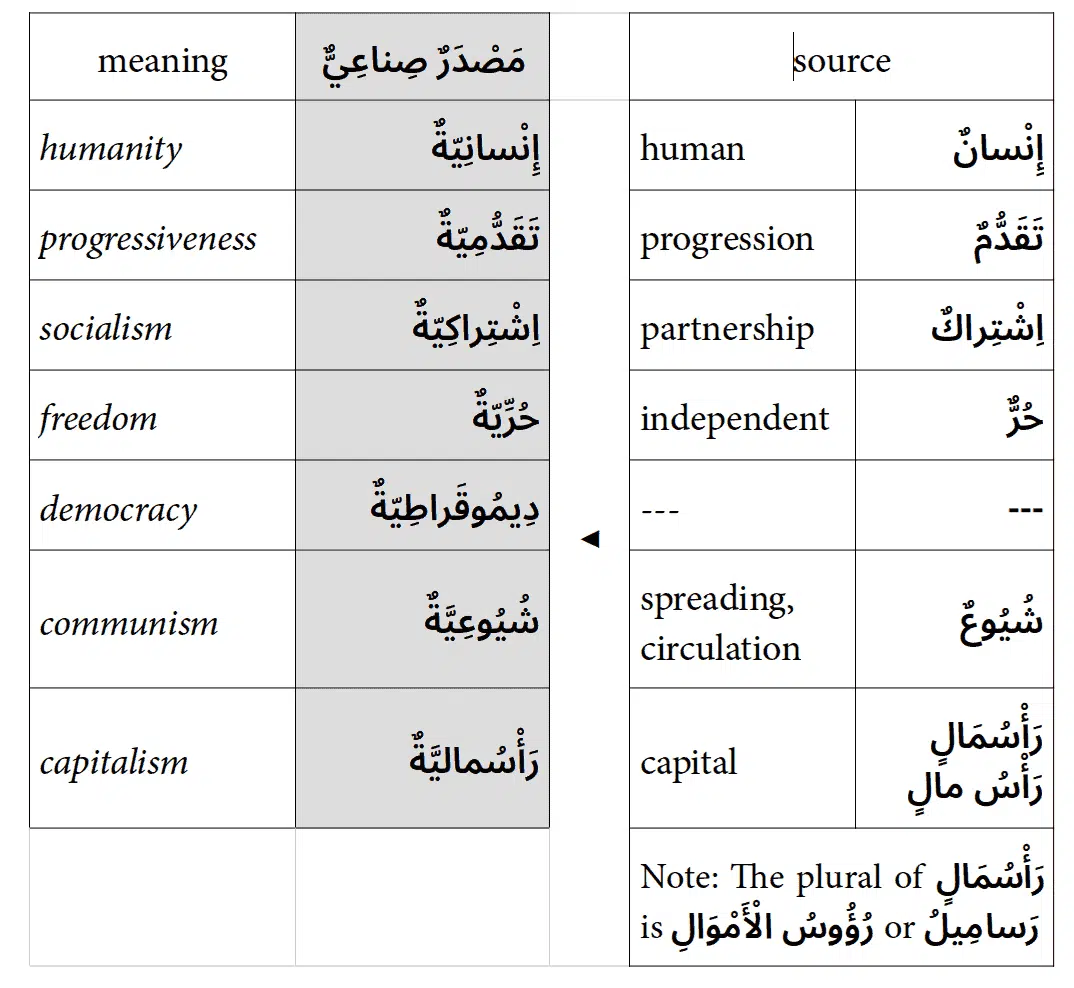
Now, if we add a ة to a Nisba resulting in يَّة, it becomes a noun indicating an abstract meaning which it did not have before this augmentation.
By this operation, we produce a so-called artificial infinitive noun (مصدر صناعي).
Many of such nouns describe abstract political, economic, or scientific terms (chemistry, biology).
In the following vocabulary list, we will see some important examples.
If you have any questions, please use the comments section.
Note: The feature image was generated by AI and is for illustration purposes only. The Arabic script in the image makes no sense – so please don’t try to decipher it ;-)
Wanna cite this article?
Drißner, G. (2022, July 4). The Masdar Sina’i – مصدر صناعي: A Simple Guide to Arabic Abstract Nouns. Arabic for Nerds. https://arabic-for-nerds.com/grammar/masdar-sinai/
Published: July 4, 2022
Please check the citation before use, especially if your style guide has local requirements.
Publication ISSN: 3055-1730


Join the discussion: Sign in with social media for instant commenting, or register with email (comments require approval):